


What Happened - The Official Policy Shift
Oracle NetSuite is phasing out its legacy SuiteTalk SOAP Web Services in favor of SuiteTalk REST Web Services. The 2025.2 release is the final planned SOAP endpoint release. NetSuite recommends building all new integrations using REST Web Services with OAuth 2.0 authentication. Organizations should begin planning SOAP-to-REST migration efforts to maintain long-term support, compatibility, and security.
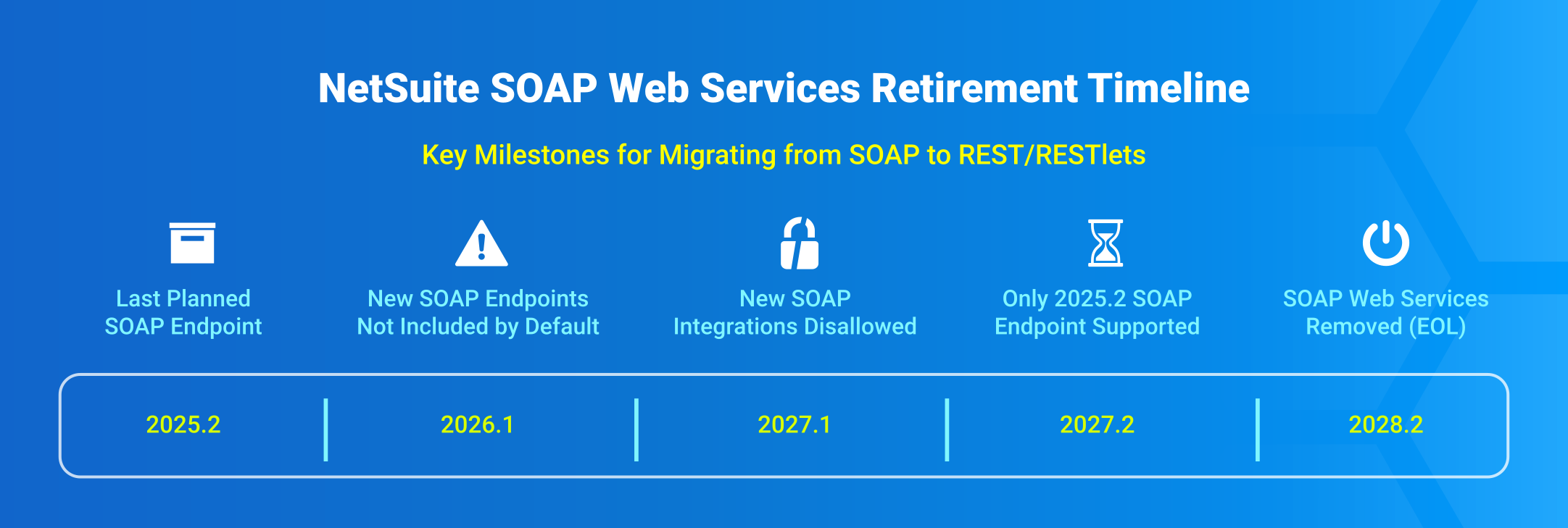
Key Timeline: The Countdown to 2028.2
Oracle’s official documentation outlines a strict phased removal:
- 2025.2: Final Planned SOAP Endpoint Release
Final planned release for SuiteTalk SOAP Web Services. - 2026.1: New SOAP Endpoints No Longer Included by Default
Oracle NetSuite will no longer include a new SOAP endpoint. - 2027.1: New SOAP Integrations Disallowed
No new integrations built using SOAP web services. - 2027.2: Minimum Support Threshold
Only the 2025.2 SOAP endpoint will be supported. - 2028.2: SOAP Web Services Removed (EOL)
SOAP web services will no longer be available in NetSuite.
Why NetSuite Is Transitioning to REST
REST Web Services align with modern API standards and continue to receive ongoing platform investment, while SuiteTalk SOAP Web Services are entering long-term maintenance and retirement phases. Below we can see the differences between the two models:
| SOAP Web Services | REST Web Services |
|---|---|
| XML-based messaging | JSON-based APIs |
| Legacy integration model | Modern REST architecture |
| Limited future platform investment | Active platform investment |
| Older authentication approaches | OAuth 2.0 support |
| Maintenance phase | Strategic integration direction |
The Migration Challenge
Many NetSuite SOAP integrations are deeply embedded in business-critical processes. Rebuilding those integrations manually can be expensive, risky, and time-consuming.
How KingswaySoft Helps
To support SOAP-to-REST migrations, KingswaySoft introduced migration-focused enhancements in the 2026 Release Wave 1 designed to simplify transitions while reducing complexity and migration risk.
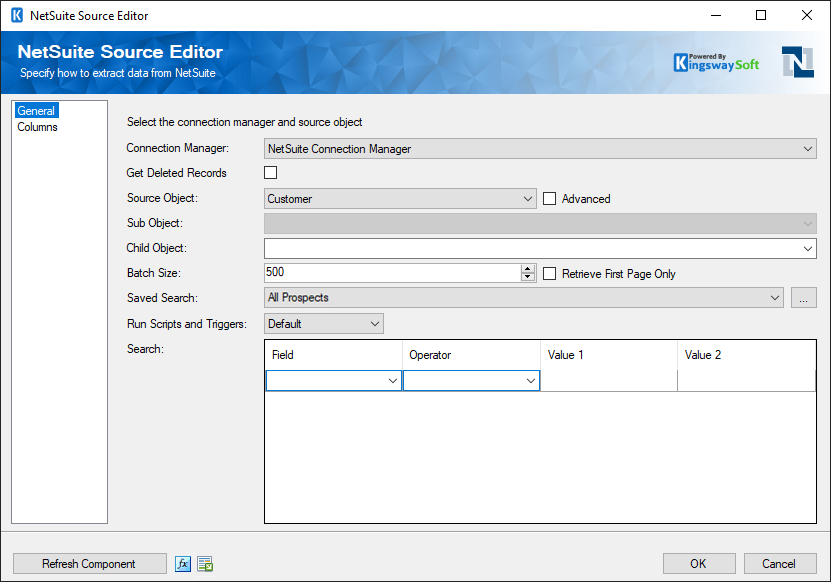
KingswaySoft's NetSuite Source component includes a built-in “Upgrade SOAP to REST” button that assists with transitioning integrations from SuiteTalk SOAP Web Services to SuiteTalk REST Web Services within SSIS.
Key Risks and Considerations
“We have dozens of existing NetSuite packages.”
Large environments often contain many interconnected SSIS packages that cannot realistically be rebuilt from scratch within a short timeline.
“Some integrations were built years ago.”
Legacy packages frequently contain undocumented business logic, custom mappings, and workflow dependencies that increase migration complexity and testing effort.
“SOAP and REST do not behave exactly the same.”
REST APIs may expose metadata, authentication methods, relationships, and record structures differently than SOAP services
“Custom segments and metadata discovery could break.”
Customized NetSuite environments often rely heavily on custom fields and custom segments, making metadata discovery and compatibility critical during REST adoption.
“We cannot afford downtime or integration instability.”
Many NetSuite integrations support business-critical operations where service interruptions or data inconsistencies can create operational disruption.
“OAuth migration introduces additional work.”
Transitioning to OAuth 2.0 authentication may require additional configuration and security updates as organizations modernize their integrations.
Why NetSuite SOAP-to-REST Migration
Is More Complex Than It Appears
Many organizations have spent years building stable SSIS-based NetSuite integrations. Replacing those integrations entirely can be expensive and time-consuming while also introducing additional operational and project risk. Projects often require:
- Replacing legacy customizations
- Accommodating REST record behavior differences
- Updating metadata discovery logic
- Revalidating field mappings and object relationships
- Handling unsupported SOAP operations
- Regression testing critical business workflows
- Updating authentication approaches to support OAuth 2.0 connectivity
Introduced in the 2026 Release Wave 1 update, KingswaySoft’s SOAP-to-REST migration-focused feature helps organizations transition from existing NetSuite SOAP endpoints to REST endpoints within their SSIS integration environment.
KingswaySoft Key Advantages for the REST Transition
- Improved visibility into metadata discovery issues, including warning diagnostics during integration configuration and migration activities.
- Support for discovery of custom segment metadata using the NetSuite REST API to improve compatibility with customized NetSuite environments.
- Support for OAuth 2.0 authentication and REST-based connectivity aligned with NetSuite’s recommended integration approach.
- Capabilities within the NetSuite Source and Destination components to assist with transitioning existing integrations from SOAP-based endpoints to REST-based endpoints within the SSIS environment.
FAQ
The 2026 Release Wave 1 update introduced a new “Upgrade SOAP to REST” button in both the NetSuite Source component. The feature is designed to help organizations migrate from NetSuite SOAP service endpoints to REST service endpoints as SOAP is gradually phased out.
The feature is available directly within the NetSuite Source Component. This allows developers to begin transitioning existing SSIS packages toward REST connectivity within the same integration environment.
The feature was added to help customers migrate from NetSuite SOAP service endpoints to REST service endpoints as the SOAP endpoint is gradually being phased out by the vendor.
Yes. The update added support for discovery of custom segment metadata when working with the NetSuite REST API. This enhancement improves compatibility with customized NetSuite environments that rely on custom segments.
Yes. The NetSuite Source Component now displays warning messages when custom field discovery fails. This enhancement helps developers identify metadata discovery issues more easily during integration configuration and migration activities.
Yes. The release includes several fixes and reliability improvements, including:
- A fix for certain numeric truncation scenarios
- Improvements to child record handling during Update and Upsert actions
- Correct handling of decimal values for non-English regional settings
- Improvements to SOAP metadata refresh behavior
Yes. The release notes include fixes and functionality related to SOAP connections, including SOAP metadata refresh improvements and SOAP-related reliability fixes. At the same time, the update introduces new capabilities specifically designed to help organizations transition toward REST connectivity.
The release notes state that the feature helps migrate from SOAP service endpoints to REST service endpoints. The documentation does not state that integrations are fully rebuilt automatically without developer validation and testing.
Yes. The update includes several REST-focused enhancements, including:
- The new “Upgrade SOAP to REST” capability
- Support for REST custom segment metadata discovery
- Improved metadata discovery visibility and diagnostics
These enhancements are intended to help organizations modernize NetSuite integrations using REST endpoints.
About KingswaySoft
KingswaySoft offers robust data enablement solutions that simplify complex integration scenarios and enhance data connectivity. These include our recently introduced JDBC Driver Pack, and over 300 SSIS components across diverse categories, such as data masking and anonymization, duplicate detection, data comparison, data profiling, advanced expression, encryption and compression, JSON & XML processing, SFTP/FTPS, and message queuing, to name a few. Many other premium components support in delivering a rapid ETL development experience using Microsoft Visual Studio and SQL Server Integration Services (SSIS) as the platform.
Our solution also includes support for connecting to NoSQL databases, cloud storage services, REST APIs, and virtually any other API or web service endpoint (SOAP or REST). Connectivity solutions are also available for facilitating data integration with enterprise applications such as Microsoft Dynamics 365, Active Directory, HubSpot, Microsoft SharePoint, Salesforce, SAP, and many more. Similarly, REST connections are available for numerous applications, including LinkedIn, Facebook Messenger, Acumatica, Zoom, Shopify, ServiceNow, and Zendesk, to name a few.
Get in touch with an integration expert
Our expert team will be available to help you plan your NetSuite SOAP-to-REST migration strategy and reduce integration risk ahead of the 2028.2 retirement timeline.