

Setting Up a Smartsheet REST Connection Manager
The REST Connection Manager is an SSIS connection manager that can be used to establish connections and facilitate data integration with REST based APIs and services such as Smartsheet, among many more.
Integration for Smartsheet is enabled by the following two components:
To add a new connection, right-click the Connection Manager area in your Visual Studio project, and choose "New Connection..." from the context menu. You will be prompted the "Add SSIS Connection Manager" window. Select the "REST (KingswaySoft)" item to add a new REST Connection Manager.
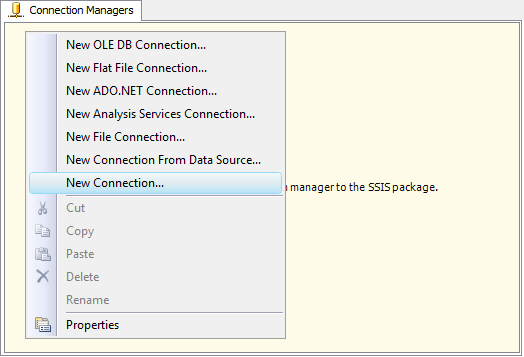
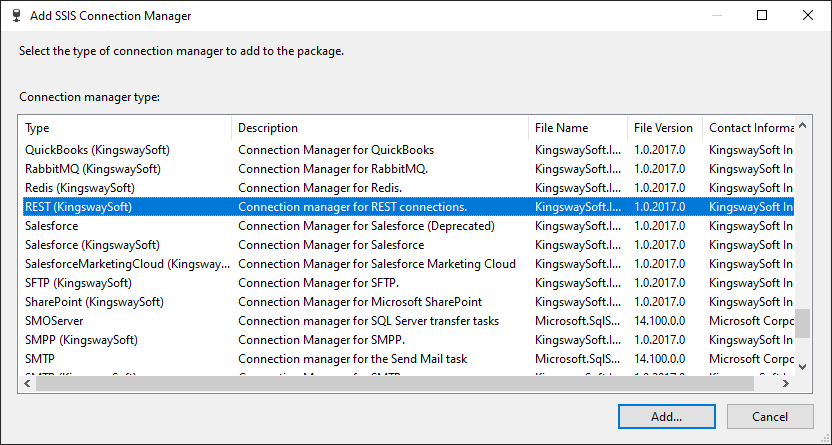
The REST Connection Manager contains 2 pages of configuration.
- General
- Advanced Settings
General Page
The General page allows you to specify connection properties and login credentials for Smartsheet REST service:
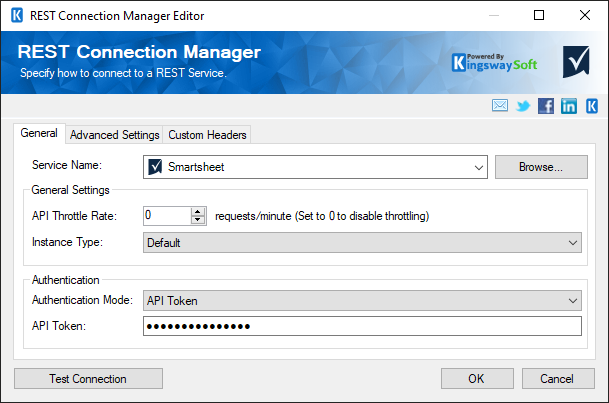
- Service Name
-
The REST service that will be connected to.
- API Throttle Rate
-
The API Throttle Rate will limit the number of requests that can be sent per second.
- Instance Type
-
The Smartsheet instance that will be connected to. The following options are available:
- Default
- Smartsheet Gov
- Smartsheet Europe
- Smartsheet Australia
- Authentication Mode
-
The Authentication Mode that will be used to connect to Smartsheet. The following options are available:
- API Token
- OAuth
-
- API Token
-
The API Token option allows you to specify the API token that will be used to authenticate requests to Smartsheet.
- Generate Token File...
-
The Generate Token File... button allows you to log in to Smartsheet and authorize the app to generate a token file.
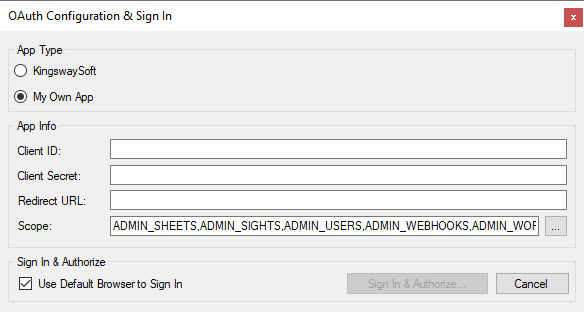
-
- App Type
-
The App Type option allows you to specify the type of OAuth application to use for authentication. The following options are available:
- KingswaySoft
- Warning: The KingswaySoft OAuth App is provided for your convenience when setting up the connection, and it should NEVER be used for production purposes.
- My Own App
- KingswaySoft
- Client Id
-
The Client Id option allows you to specify the client ID of your registered Smartsheet OAuth application.
- Client Secret
-
The Client Secret option allows you to specify the client secret of your registered Smartsheet OAuth application.
- Redirect URL
-
The Redirect URL option allows you to specify the redirect URL registered with your Smartsheet OAuth application.
- Scope
-
The Scope option allows you to specify the access scopes to request during OAuth authorization.
- Use Default Browser to Sign In
-
When this option is checked, the Sign In & Authorize button will open the system's default web browser to complete the OAuth sign-in flow. When unchecked, the sign-in flow is completed inside the toolkit.
- Path to Token File
-
The Path to Token File option allows you to specify the path to the token file on the file system.
- Token File Password
-
The Token File Password option allows you to specify the password used to protect the token file.
- Test Connection
-
After all the connection information has been provided, you may click the Test Connection button to test if the user credentials entered can connect to the selected REST service.
Advanced Settings Page
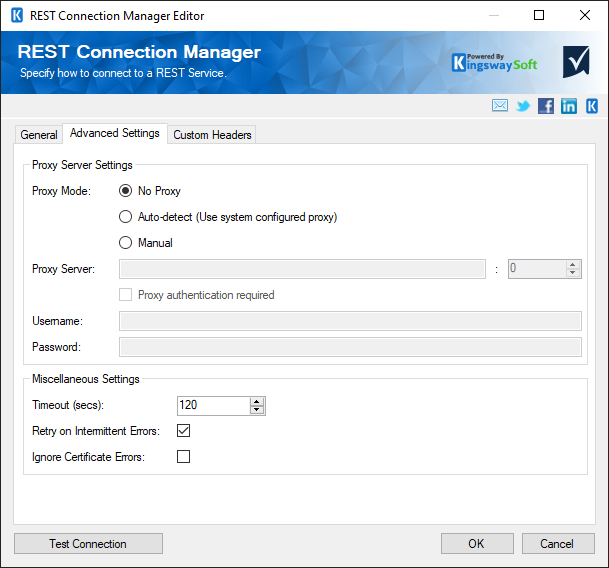
- Proxy Mode
-
The Proxy Mode option allows you to specify how you want to configure the proxy server setting. There are three options available.
- No Proxy
- Auto-detect (Using system-configured proxy)
- Manual
- Proxy Server
-
Using the Proxy Server option allows you to specify the name of the proxy server for the connection.
- Port
-
The Port option allows you to specify the port number of the proxy server for the connection.
- Username (Proxy Server Authentication)
-
The Username option (under Proxy Server Authentication) allows you to specify the proxy user account.
- Password (Proxy Server Authentication)
-
The Password option (under Proxy Server Authentication) allows you to specify the proxy user's password.
Note: The Proxy Password is not included in the connection manager's ConnectionString property by default. This is by design for security reasons. However, you can include it in your ConnectionString if you want to parameterize your connection manager. The format would be ProxyPassword=myProxyPassword; (make sure you have a semicolon as the last character). It can be anywhere in the ConnectionString.
- Timeout
-
The number of seconds requests should wait before timing out.
- Retry on Intermittent Errors
-
The retry on intermittent errors option determines if requests will be retried when there is an error. If this option is checked, requests will be retried up to 3 times.
- Ignore Certificate Errors
-
This option can be used to ignore those SSL certificate errors when connecting to SmartSheet servers.
-
Warning: Enabling the "Ignore Certificate Errors" option is generally NOT recommended, particularly for production instances. Unless there is a strong reason to believe the connection is secure, such as the network communication is only happening in an internal infrastructure, this option should be unchecked for best security.
Custom Headers Page
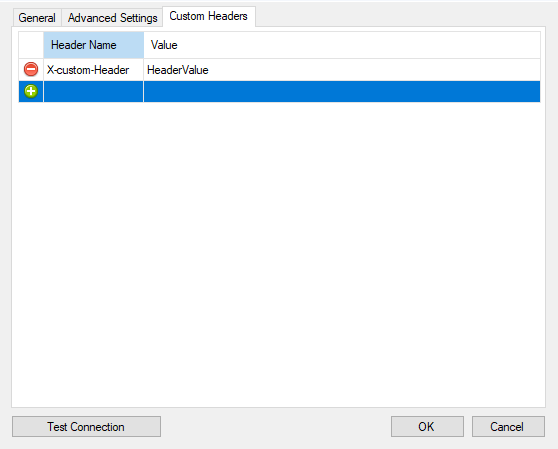
The Custom Headers page will allow you to set the Header Name and Header Value. You may select the green icon to add another row, and the red icon to remove an existing header you have configured.