

Using the Google Analytics Connection Manager
The Google Analytics Connection Manager is an SSIS connection manager that can be used to establish connections with Google Analytics.
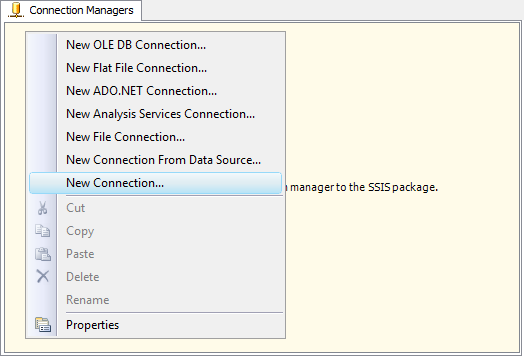
To add a new connection, right-click the Connection Manager area in your Visual Studio project and choose "New Connection..." from the context menu. You will be prompted the "Add SSIS Connection Manager" window. Select the "Google Analytics (KingswaySoft)" item to add a new Google Analytics Connection Manager.

The Google Analytics Connection Manager contains the following configuration pages:
- General
- Advanced Settings
General Page
The General page allows you to specify connection properties and login credentials to Google Analytics.

- API (since v21.2)
-
Specify a Google Analytics API to work with. Available options are:
- Google Analytics Reporting API (Legacy)
- Google Analytics Data API (for Google Analytics 4 (GA4) report data)
- Reporting API Version (Legacy) (since v8.0)
-
Specify a Google Analytics API version to work with. Available options are:
- V3
- V4
- Property Identifier (since v21.2)
-
Provide the Google Analytics 4 (GA4) property identifier to access the GA4 report data.
- Authentication Mode
-
The Authentication Mode option allows you to specify how you want to authenticate to your Google Service. Available options are:
- Authorization Code
- Service Account (server-to-server authentication)
-
These options have been deprecated and are only available in v10.0 or earlier. If you are using v.20.1 or newer, these options will not be available.
- Token Location (Available only when Authorization Code is selected)
-
Google Analytics retrieves tokens from the Google app once you give authorization. The tokens are stored in the Windows Registry so that once they expire, our component will automatically request new tokens from Google and replace the existing tokens with the new ones in the Registry to minimize user effort and avoid service interruption for scheduled jobs. You have two options to choose where in the Registry you would like to store these tokens:
- Local Machine registry hive – HKEY_LOCAL_MACHINE
- Current User hive – HKEY_CURRENT_USER
- App Type (Available only when Authorization Code is selected)
-
The selected App Type which was chosen when creating the Google token.
- Account (Available only when Authorization Code is selected)
-
The selected available Google Account Number and Name.
- Generate Token File (Available only when Authorization Code is selected)
-
This button will open a dialog that allows you to log in to the service endpoint and authorize your app to generate a new token.

- App Type
-
The App which will be used to connect to your Google Service. Available options are:
- KingswaySoft: The Connection Manager will use the Client Id and Secret that is provided by KingswaySoft for your convenience when setting up the connection, it should NEVER be used for production purposes.
- My Own App: Selecting this option will allow you to use your own Client ID and Secret to connect to Google Services.
- App Info
-
- Client Id
-
The Client Id option allows you to specify the unique ID which identifies the application making the request.
- Client Secret
-
The Client Secret option allows you to specify the secret belonging to your Google Service App ID.
- Redirect Url
-
The Redirect Url option allows you to specify the Redirect Url which was used during the Google App creation in order to complete the authentication process.
- Scope
-
The Scope option allows you to specify the scope of the token file being generated.
- PKCE
-
The PKCE (Proof Key for Code Exchange) option can be enabled to use the PKCE OAuth authorization code flow.
- Sign In & Authorize
-
- Use Default Browser to Sign In
-
When this option is checked the Sign In & Authorize button will open your default web browser in order to complete the OAuth authentication. When this option is unchecked, the Sign In & Authorize button will complete the entire OAuth authentication process inside of the toolkit.
- Sign In & Authorize Button
-
This button allows you to log in to the service endpoint and authorize your app to generate a token.
-
Warning: By default, you are using the Google AdWords API authorization information (Client Id, Client Secret & Developer Token) provided by KingswaySoft, which is provided for your convenience when setting up the connection, and it should NEVER be used for production purposes. To obtain your own Google AdWords API authorization credentials for product use, please follow the instructions in the link below to create your own application registration with Google: https://developers.google.com/adwords/api/docs/guides/signup
- Key File Type (Available only when Service Account is selected) (since v21.1)
-
Specify the private key file format that will be used for authentication. Available options are:
- JSON
- P12
In order to work with the Service Account option, a service account would need to be created in Google Console to generate a certificate key. The following steps can be used for that:
-
Log in to the Google Cloud Platform Console
-
Navigate to IAM & Admin Console.
-
Choose "Service Accounts" from the list, and then click on "Create Service Account".

-
Provide the "Service Account Name", and the "Service Account Id" would be auto-populated based on the Name.
-
Give permissions if required by switching to the "Permissions" tab.
-
Choose the "Keys" tab, and then click on "Add Key" and select "Create New Key".

-
From the window that pops up, download the private key file.
- JSON Key File Path (Available when JSON is selected as the Key File Type)
-
Specify the path to the JSON private key file used for authentication.
- Service Account
-
When JSON is selected, this read-only field displays the Service Account from the specified JSON key file. When P12 is selected, specify the Service Account associated with the P12 certificate.
- Client Id (Available when JSON is selected as the Key File Type)
-
This read-only field displays the Client Id from the specified JSON key file.
- Certificate Location (Available when P12 is selected as the Key File Type)
-
Specify where the P12 certificate used for authentication is located. Available options are:
- Store (Recommended)
- File System
- Certificate Thumbprint (Available when Store is selected as the Certificate Location)
-
Specify the thumbprint of the certificate in the Windows Certificate Store that will be used for authentication.
- Path To Certificate (Available when File System is selected as the Certificate Location)
-
Specify the path to the P12 certificate file used for authentication. Click the ellipsis button to browse the file system.
Note: The component supports an Azure Blob Shared Access Signature (SAS) URL in the certificate path.
- Certificate Password (Available when File System is selected as the Certificate Location)
-
Specify the password for the P12 certificate file.
- Test Connection
-
After all the connection information has been provided, click the Test Connection button to test if the connection settings entered are valid.
Advanced Settings Page
The Advanced Settings page of Google Analytics Connection Manager allows you to specify the advanced settings of the connection.

- Proxy Server Settings
-
The Proxy Server Settings allows you to specify how you want to configure the proxy server.
- Proxy Mode
-
The Proxy Mode option allows you to specify how you want to configure the proxy server setting. There are three options available:
- No Proxy
- Auto-detect (Using system-configured proxy)
- Manual
- Proxy Server
-
Using the Proxy Server option, you can provide a proxy server to connect to Google Analytics.
- Port
-
The Port option allows you to specify the port number of the proxy server for the connection.
- Username
-
The Username option allows you to specify the proxy user account.
- Password
-
The Password option allows you to specify the proxy user’s password.
Note: Proxy Password is not included in the Google Analytics connection manager's ConnectionString property by default. This is done by design for security reasons. However, you can include it in your ConnectionString if you want to parameterize your connection manager. The format would be ProxyPassword=myProxyPassword; (make sure you have a semicolon as the last character). It can be anywhere in the ConnectionString.
- Misc
-
- Timeout (secs)
-
The Timeout (secs) option allows you to specify a timeout value in seconds for the connection. The default value is 120 seconds.
- API Throttling Rate
-
The API Throttling Rate option will limit the number of requests that can be sent per second. This rate is set to 10 requests per second limit, by default, to respect the Google Analytics API limits.
- Retry on Intermittent Errors
-
This is an option designed to help recover from possible intermittent outages or disruption of service. It prevents the integration process from stopping due to temporary issues. Enabling this option will allow service calls to be retried upon certain types of failure. A service call may be retried up to 3 times before an exception is fired. Retries occur after 0 seconds, 15 seconds, and 60 seconds.
Warning: We have designed our retry feature carefully such that the retry should only occur when it is deemed safe to do so; however, in some occasions, such retry service calls could result in the creation of duplicate data.