


What Happened - The Official Policy Shift
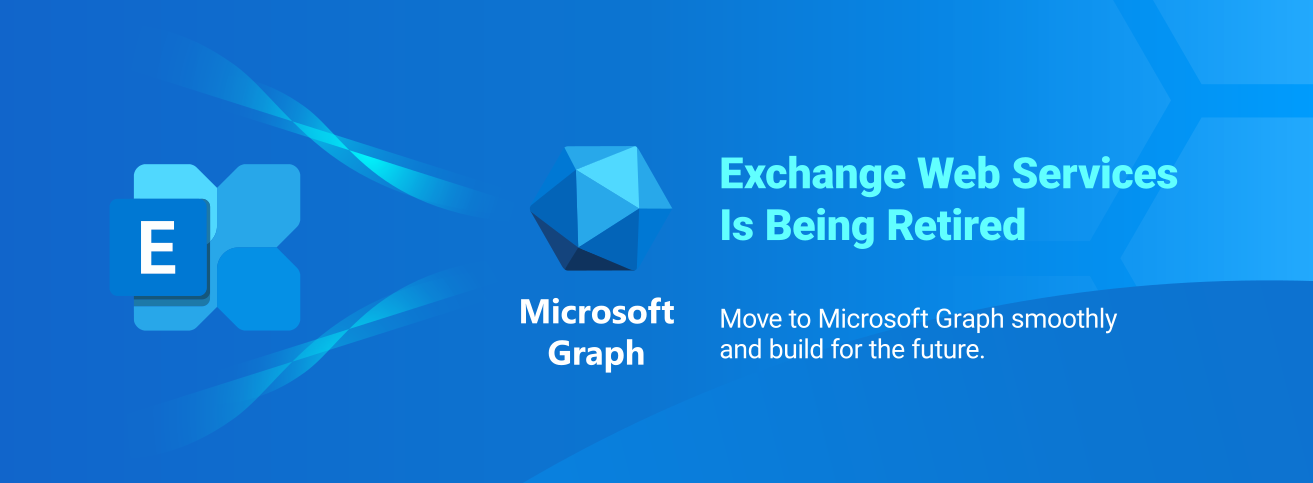
Microsoft continues to modernize the Microsoft 365 platform with ongoing improvements focused on security, performance, and developer experience. As part of this evolution, Exchange Web Services (EWS) is being retired for Exchange Online, with Microsoft encouraging developers to adopt Microsoft Graph as the modern API platform for Microsoft 365.
This transition reflects Microsoft’s long-term investment in REST-based APIs and OAuth 2.0 authentication, moving away from legacy SOAP-based technologies used by EWS. Organizations relying on EWS for Exchange Online integrations should begin planning their migration to ensure continued service compatibility.
On October 1, 2026, EWS will start being disabled by default across Exchange Online tenants, with full retirement scheduled for April 1, 2027.
Source: Deprecation of Exchange Web Services in Exchange Online
Why Microsoft Is Moving Away From EWS
Microsoft is shifting away from Exchange Web Services (EWS) in favor of Microsoft Graph to provide a unified, modern API platform for Microsoft 365 services.
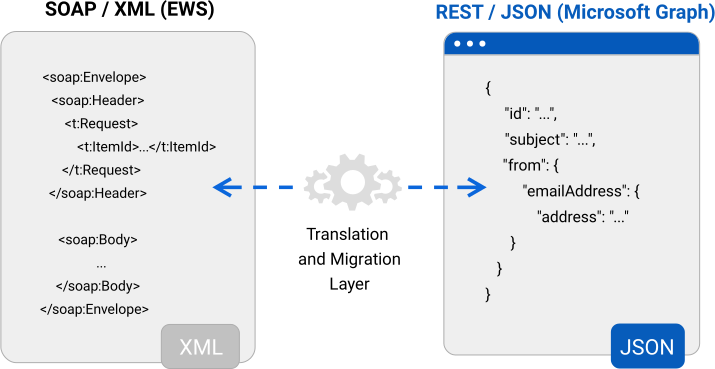
Unlike EWS, which is based on legacy SOAP/XML architecture, Microsoft Graph uses REST/JSON APIs and integrates with modern identity standards through OAuth 2.0 and Microsoft Entra ID. Key differences include:
| Exchange Web Services (EWS) | Microsoft Graph |
|---|---|
| SOAP/XML-based APIs | REST/JSON-based APIs |
| Legacy Exchange integration model | Modern Microsoft 365 integration platform |
| Limited future investment | Actively developed platform |
| Older authentication approaches | OAuth 2.0 and modern identity integration |
| Retirement path for Exchange Online | Microsoft strategic API direction |
How KingswaySoft Helps
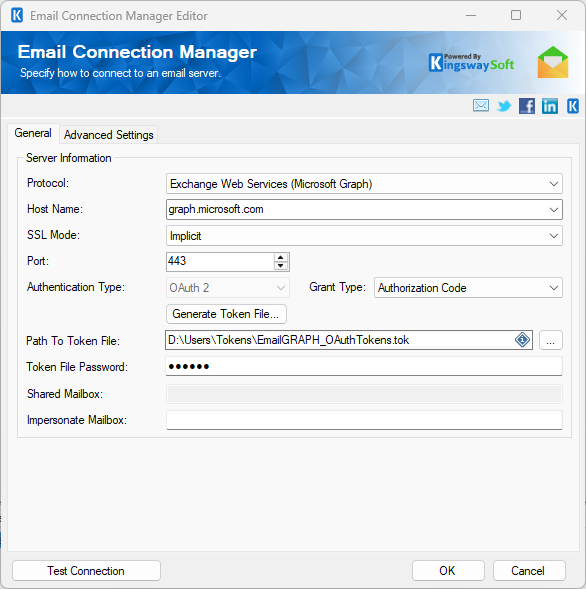
We added support for Microsoft Graph as part of our 2026 Release Wave 2, enabling a modern alternative to Exchange Web Services (EWS). The transition is designed to be straightforward, including for existing connection managers built on earlier EWS configurations.
This allows organizations to modernize their Exchange Online integrations while reducing dependency on deprecated connectivity models.
Key Advantages of Microsoft Graph
Microsoft Graph provides a modern foundation for Microsoft 365 integrations, offering:
- REST-based architecture instead of SOAP
- Modern authentication using OAuth 2.0
- Improved security and access control
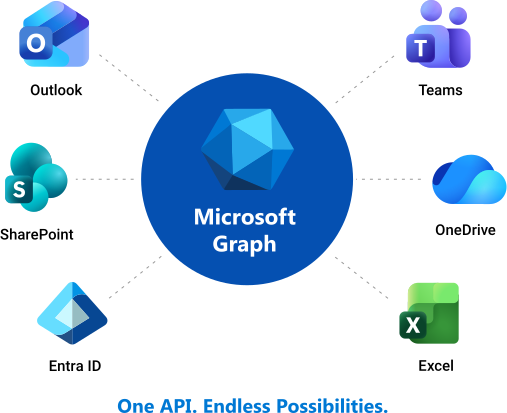
- Unified Microsoft 365 API ecosystem
- Continued feature development and investment
- Scalable cloud-native design
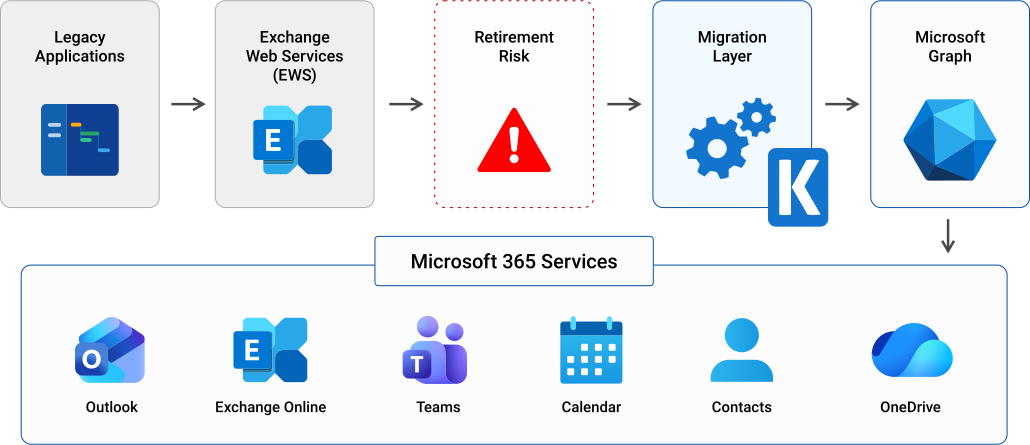
Microsoft Graph provides access to a broad set of Microsoft 365 services, including:
- Email and mailboxes
- Calendars and scheduling
- Contacts
- Files and OneDrive
- Microsoft Teams
- Users and identity data
Email Integration Solutions
Microsoft Graph Integration Support
Microsoft Graph-based integration solutions support common Exchange scenarios such as:
- Retrieving mailbox messages
- Sending emails
- Processing attachments
- Mailbox automation workflows
- ETL-based data integration
This approach aligns with Microsoft’s recommended strategy for Exchange Online integrations.
IMAP / SMTP Email Integration
For scenarios requiring traditional email protocols, IMAP and SMTP-based integrations can be used for:
- Email ingestion pipelines
- Automated message processing
- Notification systems
- Data extraction workflows
- Lightweight email automation
These approaches may serve as alternatives depending on business and technical requirements.
Microsoft Graph Limitations
While Microsoft Graph provides a modern and secure API framework, there are some functional differences compared to EWS:
- Microsoft Graph is a cloud-only service and does not support on-premises Exchange servers.
- The API requires OAuth 2.0 authentication and does not support Basic or NTLM authentication methods.
- Certain EWS capabilities, such as managing attachments (add, delete) and updating existing emails, are not available in Microsoft Graph.
- Message drafts must include all attachments and content at creation time, as they cannot be modified in the same way as EWS.
- Some message metadata fields, including Priority, ChangeKey, and Importance, are not included in Microsoft Graph.
Additional Resources
FAQ
Exchange Web Services is being retired for Exchange Online and Microsoft 365 environments. Microsoft has stated that on-premises Exchange Server deployments are not currently affected by this retirement.
Microsoft recommends using the Microsoft Graph API as the primary replacement for EWS-based Exchange Online integrations.
Organizations should begin migration planning as soon as possible and complete testing well before the October 2026 phased disablement milestone.
About KingswaySoft
KingswaySoft offers robust data enablement solutions that simplify complex integration scenarios and enhance data connectivity. These include our recently introduced JDBC Driver Pack, and over 300 SSIS components across diverse categories, such as data masking and anonymization, duplicate detection, data comparison, data profiling, advanced expression, encryption and compression, JSON & XML processing, SFTP/FTPS, and message queuing, to name a few. Many other premium components support in delivering a rapid ETL development experience using Microsoft Visual Studio and SQL Server Integration Services (SSIS) as the platform.
Our solution also includes support for connecting to NoSQL databases, cloud storage services, REST APIs, and virtually any other API or web service endpoint (SOAP or REST). Connectivity solutions are also available for facilitating data integration with enterprise applications such as Microsoft Dynamics 365, Active Directory, HubSpot, Microsoft SharePoint, Salesforce, SAP, and many more. Similarly, REST connections are available for numerous applications, including LinkedIn, Facebook Messenger, Acumatica, Zoom, Shopify, ServiceNow, and Zendesk, to name a few.
Get in touch with an integration expert
Our team can help you evaluate EWS dependencies, plan your migration strategy, and reduce integration risk ahead of the Exchange Online retirement timeline.